The Greek our parents made in Australia and America
To Booko is a dictionary of Greeklish: the English words that Greek migrants took into their Greek and made their own, with Greek articles, Greek endings and Greek grammar, in Australia, the United States, Canada, South Africa and Britain. It is the work of The Greeklish Project, started by Kyriakos Gold in 2010.
What Greeklish is
Greeklish here does not mean Greek typed in Latin letters. It means the language Greek families spoke at home, at work and in the shop after migration: a Greek sentence carrying English words that had been given a Greek article and a Greek ending. The car became το κάρο, the market became η μαρκέτα, the roof became το ρούφι.
Linguists call this an ethnolect. Professor Ghil'ad Zuckermann of the University of Adelaide described it to SBS News in 2015 as a blend of languages spoken by one ethnic group living in a bilingual setting, and said its speakers still gain the benefits of being bilingual.
How the words work
- το ρούφι, το φλόρι: many borrowed nouns became neuter and took an ι ending.
- η μαρκέτα, η στόφα: others became feminine and took an α.
- ο μπίλντας, ο γουέλντας: words for tradesmen became masculine, ending in ας.
- Verbs took Greek endings and conjugated like any Greek verb.
- Some borrowings landed on Greek words that already existed. ρουφιάνος is an informer in Greece and a roof repairer in Melbourne.
Two generations, two kinds of Greeklish
Most of the vocabulary in this dictionary comes from the Greeks who arrived in Australia in the 1950s and 1960s. Writing in Neos Kosmos in 2015, Dean Kalymniou described their Greeklish as mostly nouns and adapted verbs, following Greek grammar closely, and fading as that generation ages: ορράιτ, μαρκέτα, καρπέτο, κάρο.
Their children turned it around. Their Greeklish was English carrying Greek pieces: argisied for delayed, nistepsying for fasting, to give logies for getting engaged, and I opened the light, a Greek phrase translated word for word. Kalymniou dated its peak to the 1990s. Later generations tend to speak either English or Greek.
The same thing happened in the United States, where an earlier wave of Greek migrants built their own words for the same new world. The American entries here come from the Greek diaspora press in New York and Boston and from community lists.
How the project came about
Kyriakos Gold was raised in Thessaloniki, in a family of Greek Australian ancestry, and learned English there before the internet, in a city that spoke one language. In 1995, studying Greek culture at the University of Adelaide, he began exploring the versions of Hellenism and Hellenic identity that Greeks had made for themselves around the world. The Greek spoken in Australia was part of that question, and it never let him go.
His media work kept putting the language in front of him, and his programs kept a record of it. By about 2009 he had understood how much of it there was: not a handful of funny words, but a vocabulary with its own grammar, built by two generations in every suburb where Greeks had settled. In 2010 he made it a research project, The Greeklish Project. When Neos Kosmos reported its plans in June 2015, there was to be an online database where Greek Australians could add their own words, a dictionary, and a call for volunteers. Gold told the paper that Greeks from Greece sometimes frowned on the language of Greek Australia, and that he saw it differently: I see that there's a hybrid here
. Protothema in Athens picked the story up the same week, and in July 2015 SBS News reported on the project alongside Chinglish, Hinglish, Spanglish and Taglish.
Then the research became a show. On 25 July 2015, at the Greek Centre in Melbourne, Gold hosted the first Greeklish night: an immersive comedy performance built on the research, part stand-up and part game show, in which people from the audience tested their Greeklish on stage, Helen Kapalos, George Donikian and Dean Kalymniou sat on the panel, musicians played between rounds, and the winner was crowned Melbourne Greeklish Champion. It came back to the Greek Centre in October 2016 for two nights, the second added after the Saturday sold out. Gold spoke then of building a website and writing a book, and by August 2016 Greek Reporter was already describing the planned site by name, tobooko.com, as one database for the Greeklish of Australia, North America and South Africa.
To Booko is that website. Every Australian word in it is also recorded in The Greeklish Project, and anyone can add a word, comment on one, or say where they heard it.
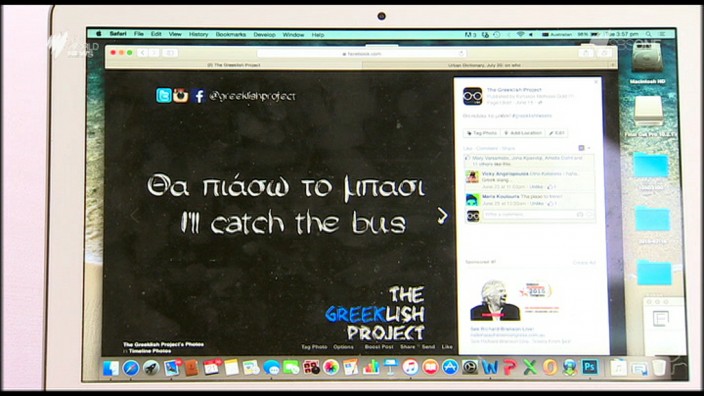 Watch on SBS News The Greeklish Project and speaking hybrid languages, July 2015
Where the words come from
The core of the Australian list is the fieldwork of Anastasios Tamis, published in 1986 and 2011, together with Dean Kalymniou's columns in Neos Kosmos and The Greeklish Project's own collection. The American list draws on Greek community newspapers and websites in the United States, and on Lisa Matejka-Hanser's 2011 study of Greek as spoken in Chicago. Canada comes from Angela Ralli and Vasiliki Makri's work on the Greek of Canadian migrants.
South Africa has an unexpected witness. In February 1942 the poet George Seferis, posted to the Greek legation in Pretoria, wrote into his diary a small glossary of the Greek he heard in the Transvaal: το τιρούμι for the tea room, η φάμαρα for the farm, το μπάισκόπι for the cinema. Nikos Sarantakos republished it in 2013, and those words are here marked as a historical record. Britain comes from the Grenglish Project of Anna Charalambidou and Petros Karatsareas, who collected the Greek of London's Cypriots between 2019 and 2022.
Words added by visitors are checked by the editors before they appear, and each one carries the name of the person who sent it.
The project in the press
- Neos Kosmos, The Greeklish Project, 23 June 2015
- Protothema, A dictionary that tells you why you can't put chopia in your bootey, 25 June 2015
- Neos Kosmos, Let's hear it for Greeklish, 17 July 2015
- SBS News, The Greeklish Project and speaking hybrid languages, 24 July 2015
- Νέος Κόσμος, Μια γιορτή για την ελληνοαυστραλιανή «κάλτσα», 28 July 2015
- Neos Kosmos, Dean Kalymniou on The Greeklish Project, 3 August 2015
- Greek Reporter, To Booko: the Greek Australian dictionary of the Greeklish dialect, 19 August 2016
- Greek City Times, Kafedaki with Kyriakos Gold, 26 October 2016
- The Greek Quarter, The Greeklish Project returns to the Greek Centre, October 2016
- SBS Greek, Through the Greeklish Project parts of the Greek community come together, 27 October 2016
Where the words were recorded
- Anastasios Tamis, fieldwork on the Greek of Australia, published in Glossologia (1986) and Hellenic Studies (2011)
- Nikos Sarantakos, Μικρό γλωσσάρι της ελληνοτρανσβαλικής γλώσσας (1942), from Seferis, Μέρες Δ΄
- Angela Ralli and Vasiliki Makri, Examining the integration of borrowed nouns in immigrant speech: the case of Canadian Greek
- Lisa Matejka-Hanser, Greek American Greek: lexical borrowing in the speech of Greek Americans, Wiener Linguistische Gazette 75, 2011
- The Grenglish Project, Middlesex University and University of Westminster, 2019 to 2022